 English
  français
  Deutsch
  Español
  italiano
  русский
  português
  العربية
  ไทย
ไทย  tiếng việt
  Pilipino



What are you looking for?

For most bathroom mirror applications, an IP44 LED driver can be appropriate when the driver is installed in a protected location and is exposed mainly to humidity or occasional splashing. IP67 should be considered where the driver may face heavier water exposure, temporary immersion risk, or a more demanding installation environment.
The correct specification depends on the actual installation zone, driver position, mirror construction, water exposure, SELV requirements, and local electrical regulations. Choosing IP67 simply because it has a higher number can increase cost and may provide no practical benefit in a properly designed bathroom mirror.
IP ratings classify enclosure protection against solid objects and water ingress under IEC 60529.
For LED drivers, the practical difference is:
| Specification | IP44 | IP67 |
|---|---|---|
| Solid-object protection | Objects ≥1 mm | Dust-tight |
| Water protection | Splashing water | Temporary immersion |
| Typical environment | Protected indoor bathroom installation | Higher water-exposure environments |
| Enclosure sealing | Moderate | High |
| Typical cost | Lower | Usually higher |
An LED driver IP44 is protected against solid foreign objects of 1 mm or larger and against splashing water. IP67 provides complete dust protection and protection against temporary immersion; IEC-based guidance commonly defines the IPX7 test as approximately 30 minutes at 1 m depth.
This does not mean an IP67 driver should actually be installed underwater. The rating describes defined test conditions rather than recommending submerged operation.
Yes, IP44 can be sufficient for many bathroom mirror installations when the driver is positioned away from direct water exposure and the installation complies with the applicable electrical requirements.
For example, UK BS 7671 guidance requires at least IPX4 for relevant electrical equipment in bathroom Zones 1 and 2, while Zone 0 requires IPX7. Requirements can differ by market, so the destination country's regulations should always be checked.
An LED driver for bathroom mirror applications may therefore use IP44 when:
It is mounted behind or inside a protected mirror structure.
It is not exposed to direct shower spray.
The installation location requires protection against splashing rather than immersion.
The complete mirror design provides suitable additional protection.
Local electrical regulations permit the configuration.
The driver IP rating should always be considered together with the complete mirror assembly.
IP67 is more appropriate when water exposure is significantly higher or when the installation environment cannot reliably protect the driver.
Typical situations include:
Drivers installed close to areas with frequent water spray
Installations where water may accumulate around electrical components
Wet-room applications with more demanding exposure
Designs where the driver enclosure itself provides the main water barrier
Projects with specifications explicitly requiring IP67
However, IP67 should not automatically replace an IP44 LED driver.
A highly sealed driver can also have different thermal characteristics. Because LED-driver lifetime is strongly affected by operating temperature, the supplier should verify that the chosen driver can dissipate heat properly when installed in a confined space behind the mirror.
SELV is especially relevant when LED systems operate at extra-low voltage in environments where electrical safety is important.
A LED driver SELV IP44 combines two different characteristics:
SELV relates to electrical isolation and output-voltage safety.
IP44 relates to the enclosure's protection against solid objects and water.
They should not be treated as interchangeable specifications.
LED-driver manufacturers note that SELV requirements under LED-lighting standards involve safety isolation through reinforced or double insulation and limits on output voltage.
For bathroom mirror projects, buyers should confirm:
Whether the output is SELV
Rated output voltage, such as 12 V or 24 V DC
Maximum output power
Isolation class
Applicable safety certification
Compatibility with the mirror's LED load
A driver described only as “IP44” does not automatically mean it is SELV.
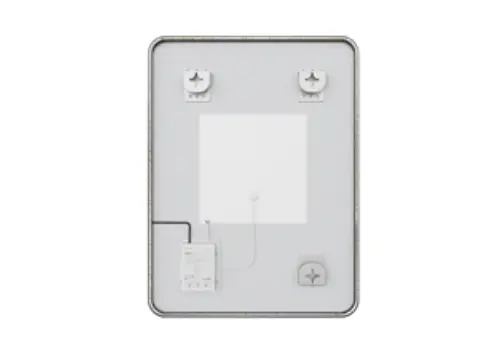
Yes, and this is common, but sufficient space, ventilation, cable routing, and moisture protection must be designed into the mirror.
The driver should not simply be placed wherever space is available.
When evaluating an LED driver for bathroom mirror installations, check:
Installation space:
There should be sufficient clearance for the driver body, connectors, and cables.
Heat dissipation:
Avoid positioning the driver directly against heat-sensitive materials or in an unnecessarily sealed cavity unless the design is intended for it.
Water path:
Consider whether condensation or water entering around the mirror could reach the driver.
Service access:
The driver should ideally be replaceable without removing or damaging major mirror components.
Cable entry:
Cable routing should preserve the intended ingress protection of the driver and mirror assembly.
For hotel projects and large residential developments, these details should be confirmed in the product drawing before mass production.
A professional driver specification should contain more than the IP rating.
Before approving an IP44 LED driver, confirm:
| Item | Specification to Check |
|---|---|
| Input | Voltage and frequency |
| Output | Constant voltage or constant current |
| Output voltage | For example, 12 V or 24 V DC |
| Power | Matched to LED load with appropriate margin |
| Safety | SELV requirement if applicable |
| IP rating | IP44, IP67, or project-specific requirement |
| Dimming | Non-dimming, phase-cut, 0–10 V, DALI, etc. |
| Protection | Short-circuit, overload, over-temperature as required |
| Dimensions | Must fit the available mirror cavity |
| Certifications | Based on destination market |
| Connection | Terminal, connector, or cable configuration |
For custom LED mirrors, the driver should be selected after the LED strip power, total wattage, control system, and installation space have been finalized.
One of the most common mistakes is specifying IP67 simply because it appears safer.
A better approach is to match the protection level to the actual installation conditions.
Other common problems include:
Considering the driver IP rating but ignoring the complete mirror design
Assuming IP44 automatically means SELV
Using a driver with insufficient wattage
Ignoring heat buildup behind the mirror
Failing to confirm destination-market certification
Changing the LED strip without recalculating driver load
Installing connectors in areas with lower protection than the driver itself
The protection level of the electrical system is only as reliable as its weakest component.
The choice between an IP44 LED driver and IP67 should be based on actual water exposure, bathroom installation zone, mirror construction, driver position, and regulatory requirements.
For many wall-mounted bathroom mirrors, LED driver IP44 protection can be suitable when the driver is located in a protected position and the complete mirror is properly designed. IP67 becomes more relevant when greater water-ingress protection is genuinely required.
For OEM and project buyers, Chalaat Mirror recommends defining the LED load, output voltage, SELV requirement, IP rating, installation position, dimensions, control method, and target-market compliance together rather than selecting the driver by IP rating alone.
Yes. IP44 can be suitable in locations requiring splash protection, subject to the installation zone and local regulations.
IP67 provides higher ingress protection, but it is not automatically the better choice for every bathroom mirror.
It indicates protection against solid objects of 1 mm or larger and against splashing water.
No. IP44 provides splash protection; it is not rated for immersion.
IP67 is tested for temporary immersion under defined conditions. It does not mean the driver should be used continuously underwater.
No. SELV relates to electrical safety and isolation, while IP44 describes ingress protection.

The maximum supported file size is 10MB, for larger attachment or multiple files Bang Phli District, Samut Prakan Province, Thailand.
Please contact us for better tranfer channels!