English
 français
 Deutsch
 Español
 italiano
 русский
 português
 العربية
 ไทย
 tiếng việt
 Pilipino


What are you looking for?

If you’re choosing LED strip lights for cabinets, wardrobes, display cases, or commercial lighting projects, you might be torn between COB and SMD. We won’t get into complicated definitions; instead, we’ll focus on real-world applications to help you understand the differences between the two in terms of luminous efficacy, heat dissipation, cost, and installation—so you can decide which one is right for you.
Structurally, the biggest difference between COB and SMD lies in the packaging and arrangement of the LED chips.
Typically, multiple bare LED chips are mounted directly onto a PCB substrate and then covered with a continuous phosphor coating to form a continuous light-emitting surface.
These typically involve mounting pre-encapsulated SMD LEDs onto a PCB via surface-mount technology. Each LED serves as an independent light-emitting unit.
Simply put, COB strips have a more continuous light-emitting surface, while SMD strips are composed of individual SMD LEDs.
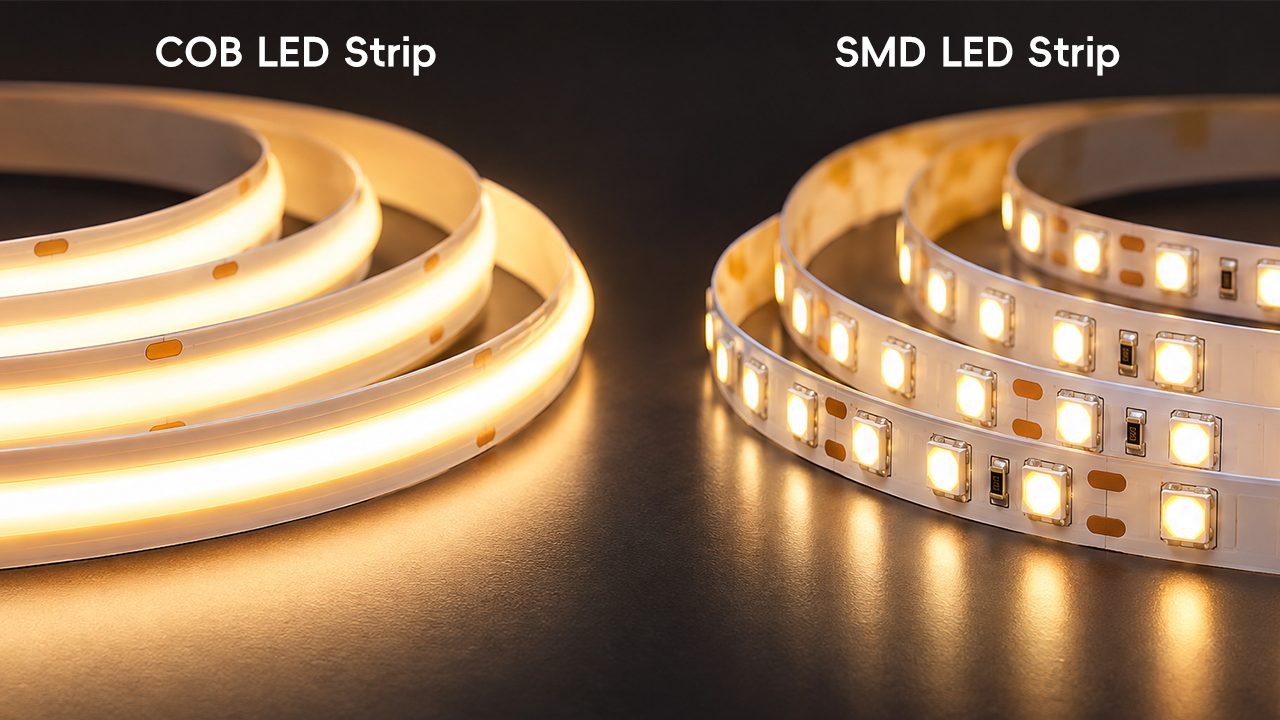
Because the phosphor layer provides continuous coverage, the light output forms a uniform strip; even when the strip is very close to the illuminated surface, no individual light spots are visible.
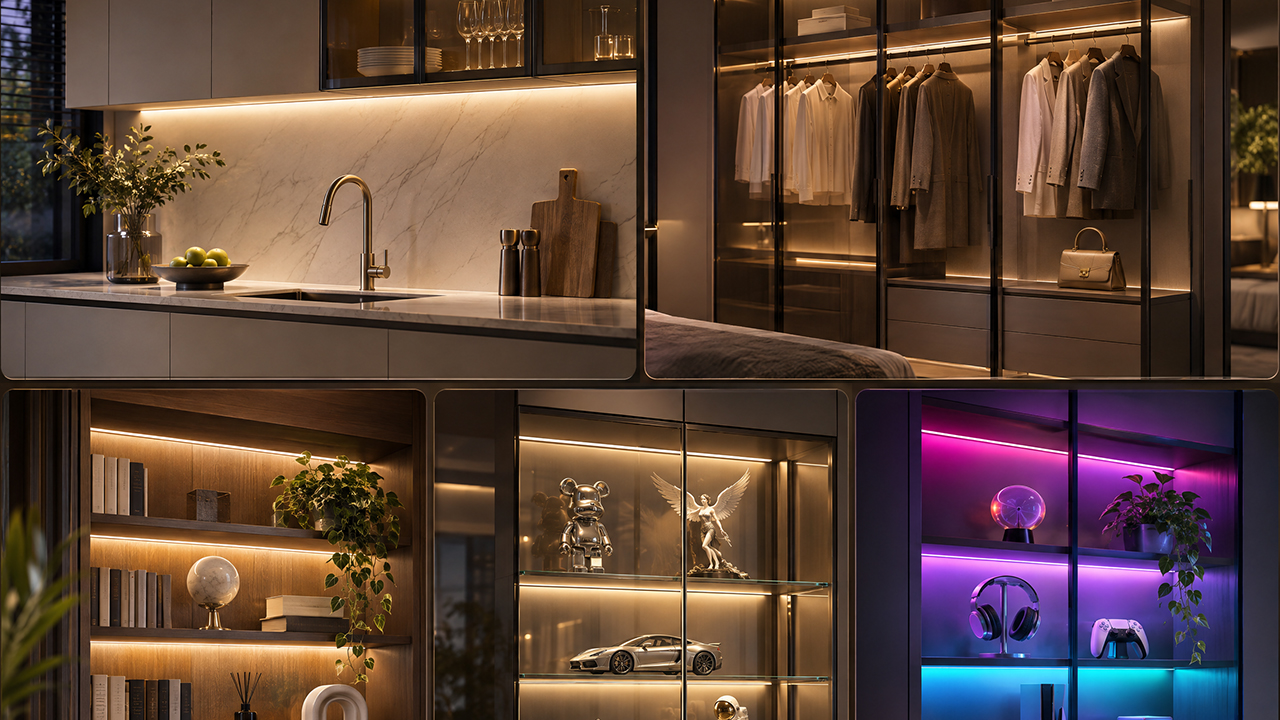
Suitable Applications: Close-range lighting such as under cabinets, wardrobe shelves, and display counter tops, where light spots are the primary factor affecting visual appeal—COB offers a significant advantage in these scenarios.
This is not a flaw of SMD; it is determined by its structure. To improve this, you must either choose high-density SMD or add a diffuser or aluminum channel. However, high-density SMD increases costs, and adding a diffuser takes up installation space. Therefore, you should understand that the spot-free effect of SMD comes at an additional cost, whereas COB achieves it inherently due to its structure.
Many people assume that COB is always brighter than SMD, but that’s not true. Brightness is measured in lm/m and lm/W, not by the type of strip. High-power SMD can be brighter than standard COB, and high-density COB can also achieve very high brightness. When comparing brightness, look at the actual test data for specific models, not the “COB” or “SMD” label.
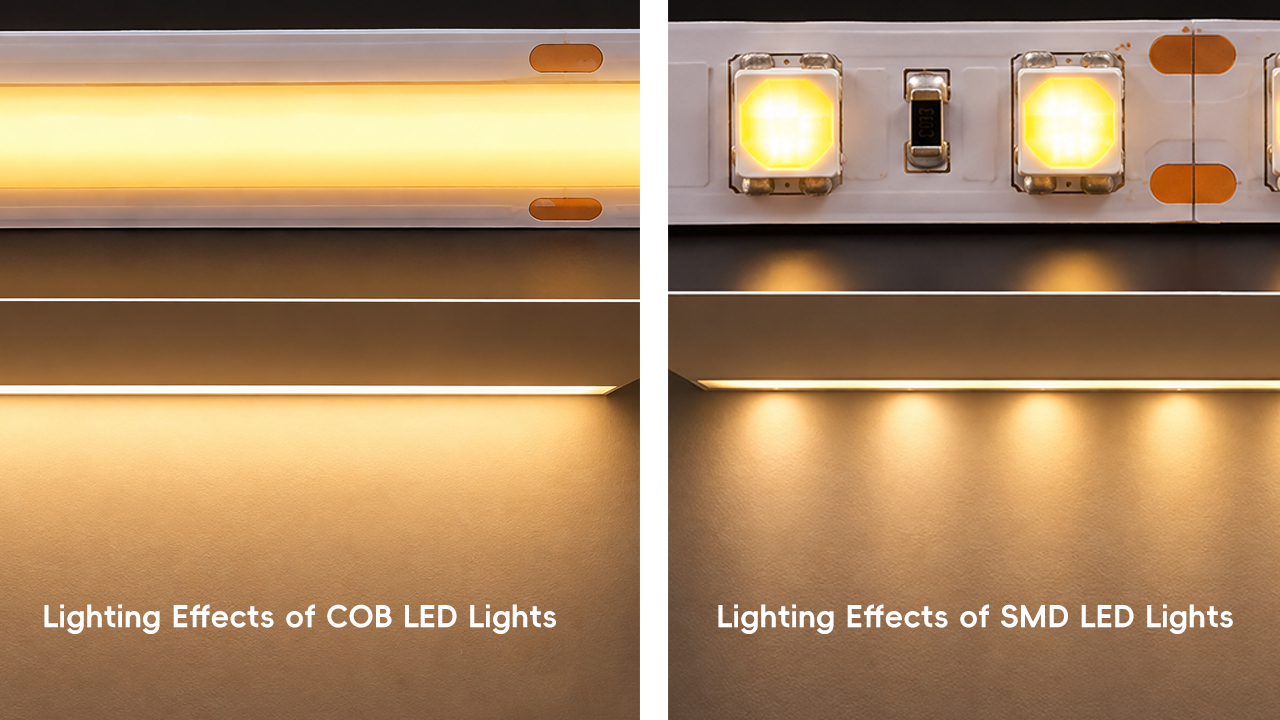
LED density not only affects the uniformity of light output but also influences the overall heat dissipation design.
High density results in more uniform light output, but it can also lead to higher power density per unit area. This means COB strips are more sensitive to PCB copper thickness and heat dissipation design. If you were to attach a high-density COB bare board directly to a wooden panel, the heat would not be able to dissipate properly, which would negatively impact both light decay and lifespan.
Low-density SMDs have lower thermal demands but produce a more pronounced light spot; high-density SMDs improve the light spot but also require more effective heat dissipation.
Therefore, regardless of which type you choose, we recommend using aluminum profiles for cabinetry projects. Aluminum channels address both heat dissipation and light diffusion; COBs paired with aluminum channels offer a cleaner visual appearance, while SMDs paired with diffuser covers can significantly reduce the light spot.
Heat dissipation is also related to the thickness of the copper on the PCB. When comparing options, the copper thickness is a more critical factor in determining long-term reliability than the choice between “COB or SMD.” Without sufficient copper thickness, even the best chips cannot withstand thermal degradation.
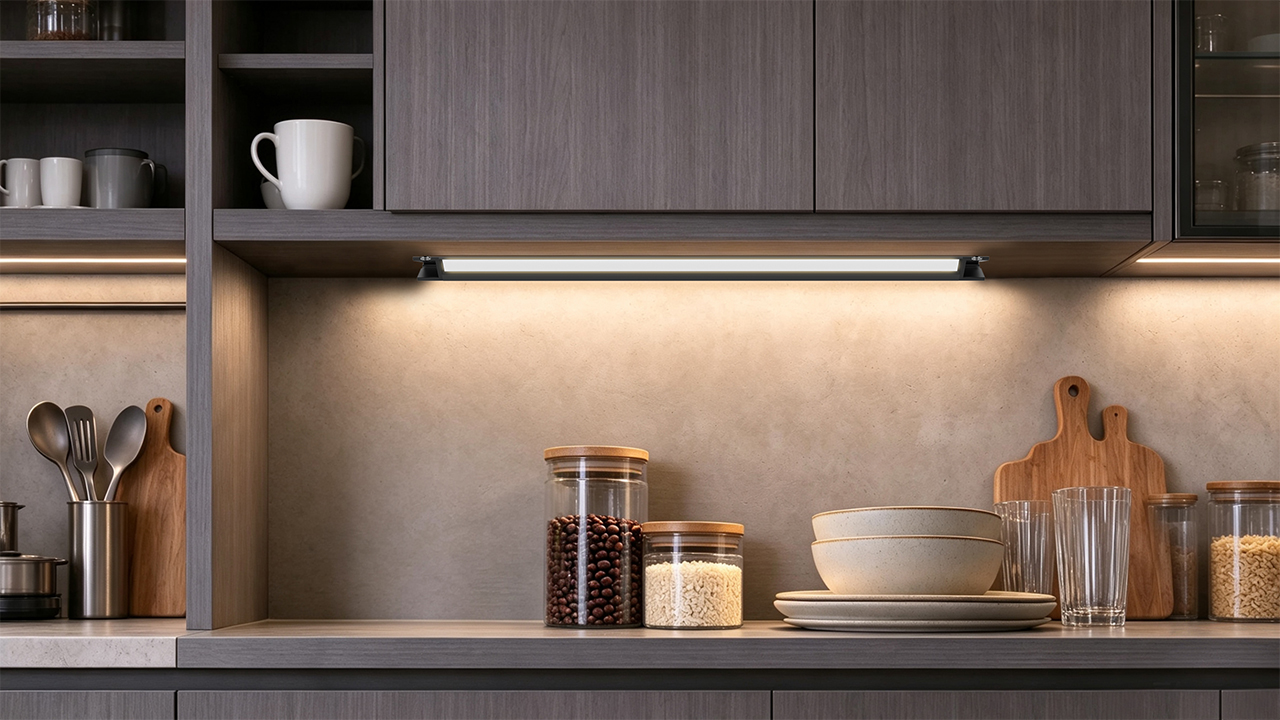
Cabinet lighting is close to the human eye, and the consistency of CRI and color temperature directly determines whether the effect you see is high-quality. Both COB and SMD can achieve Ra > 90 and SDCM < 3, but whether this is achievable depends on the supplier’s chip quality and their ability to sort by spectrum and color—not on the type of light strip.
If you plan to join multiple light strips in the same space, color discrepancies will be very noticeable if SDCM isn’t properly controlled. This is especially true for COB, since its light emission is continuous; once a color discrepancy occurs, it results in a color deviation along the entire strip, which is more glaring than the localized color variations seen with SMD. Therefore, when selecting COB, you must verify that the SDCM is less than 3 based on actual test data.
Standard COBs have fixed cutting points, so you can only cut along the marked lines. Free-cut COBs offer more flexibility, but you must confirm the minimum cutting length and assess the impact of cutting on the structure and waterproofing. SMDs are cut by group; each group has a fixed voltage and current, so you must carefully check the group markings when cutting.
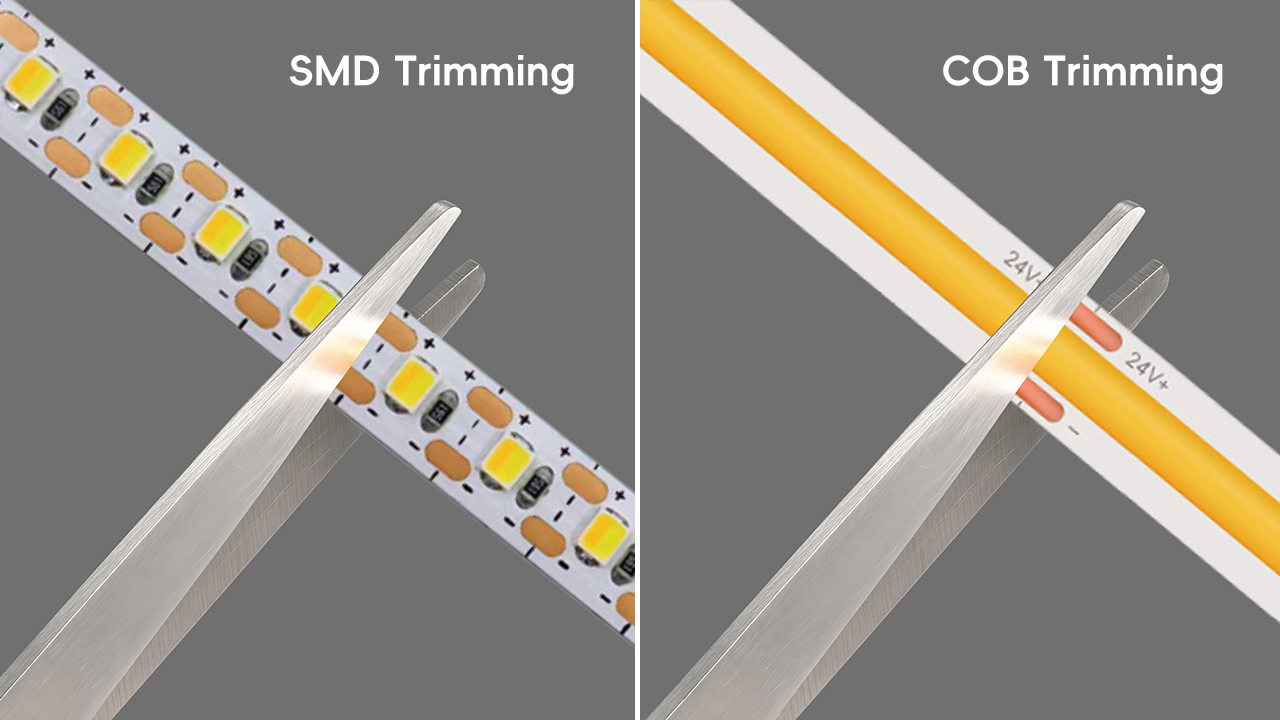
If project dimensions are irregular—such as when wardrobe shelves vary in length or display cabinets have non-standard shapes—the cutting spacing directly determines your material waste rate. The smaller the cutting spacing, the less waste there is, but the cost is typically higher as well. You need to calculate this trade-off based on the project’s actual dimensions; smaller isn’t necessarily better.
When lights are connected in series over long distances, brightness at the end of the string will decrease. This issue affects both COB and SMD strips; it is not related to the type of strip but rather to voltage, power, and series length. For projects involving long distances, prioritize 24V or 48V systems. When using single-ended power supply, pay close attention to the maximum series length—don’t wait until after installation to discover that the ends are dim and then have to redo the work.
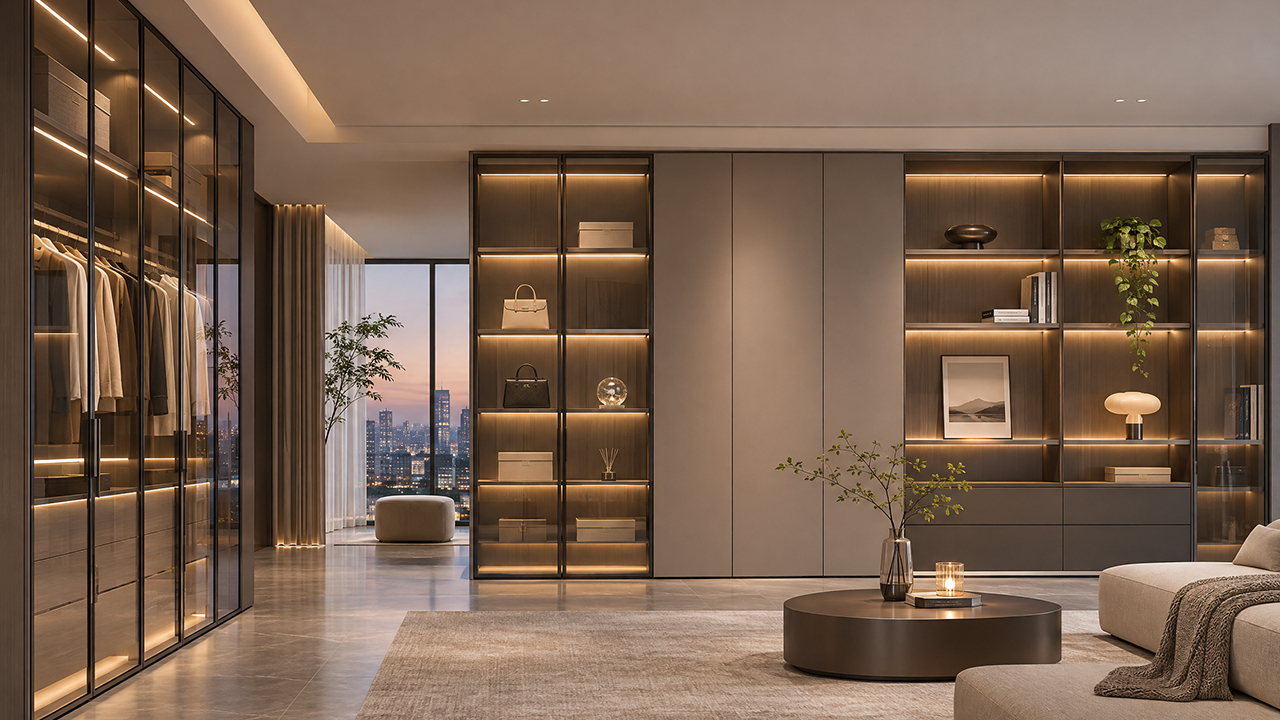
The differences between COB and SMD are typically most evident in cabinet and furniture lighting. Since these strips are often installed close to the illuminated surface, the uniformity of the light and consistency of color directly affect the final product’s appearance.
1) For under-cabinet lighting, COB is the preferred choice. Ensure the CRI is ≥90, the voltage is 24V, it comes with an aluminum channel, and it meets IP20 standards. The key considerations are the absence of light spots at close range and consistent color temperature.
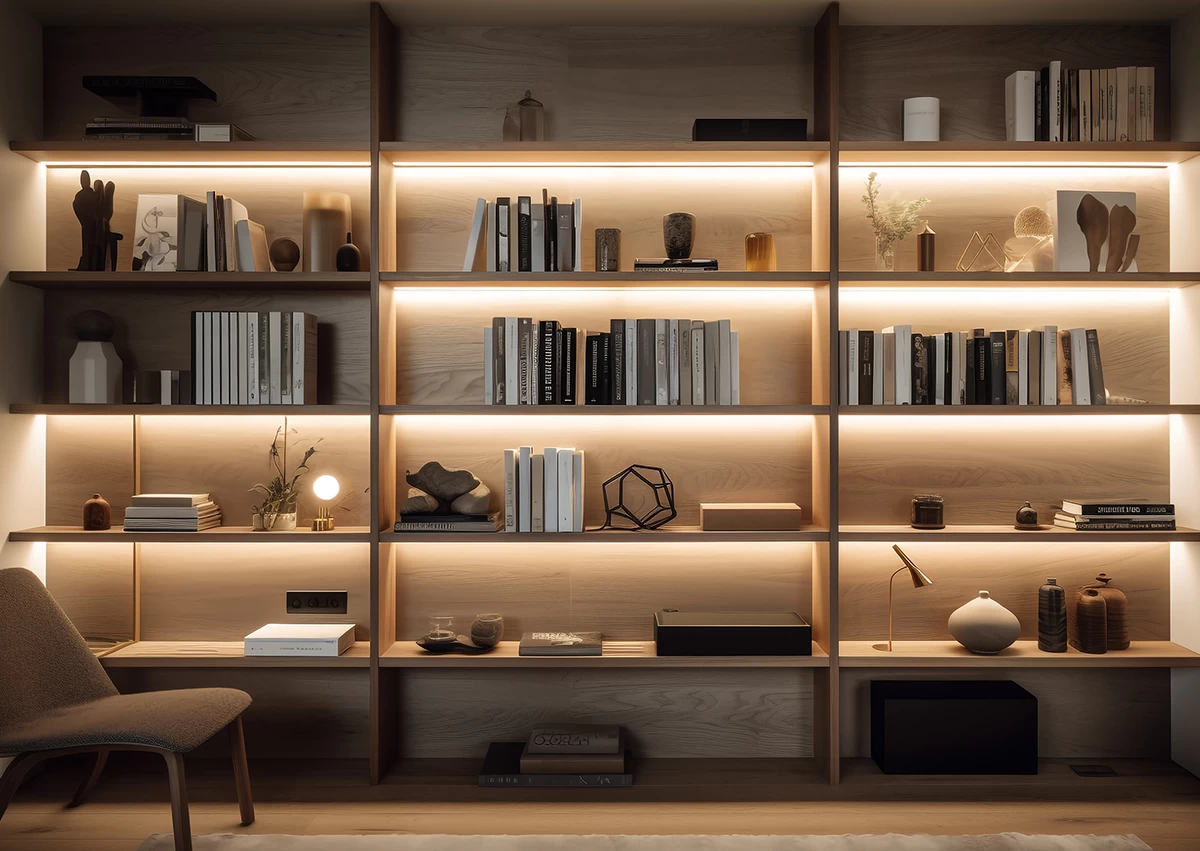
2) For wardrobe and bookshelf shelves, COB is also the preferred choice. Focus on cutting intervals and color temperature consistency; flexibility in cutting is crucial when shelf lengths are irregular.
3) For display cases and retail displays, COB offers greater stability. Prioritize confirming that SDCM < 3 and that the lights are dimmable, as display lighting demands the highest level of color consistency.
4) For budget-conscious cabinetry projects, SMD can be used, but you must pair it with aluminum channels and diffuser covers, and ensure the lumens per meter (lm/m) are sufficient; otherwise, both light spots at close range and insufficient brightness will occur simultaneously.
5) For RGB ambient lighting in cabinets, SMD is more suitable, as controllers and light strips are well-matched, and there is a wide range of color options available.
Both COB and SMD LEDs can be built to be very durable, but due to their different structures, they “fail” in different ways.
A COB LED emits light as a single continuous strip; if the quality of the outer phosphor coating is poor, it may yellow or dim in sections over time;
SMD consists of individual LEDs; if heat dissipation is inadequate for a particular LED, it may dim prematurely or even fail completely. Therefore, when evaluating lifespan, check whether the manufacturer provides authentic L70 test reports (the time it takes for light output to decay to 70%) and LM-80 certification data.
Additionally, heat dissipation is the “make-or-break” factor determining how long these two types of light strips will last. Because of its high chip density, COB relies heavily on the outer aluminum heat sink to help conduct heat; similarly, SMD requires enhanced heat dissipation when operating at high power. If your cabinet is completely sealed and the interior is stuffy and hot, regardless of which type of light strip you choose, we recommend installing an aluminum heat sink and even leaving a little space for ventilation.
CHALAAT’s Thailand factory works directly with cabinet manufacturers, furniture brands, and commercial contractors to provide you with customized low-voltage lighting solutions using COB and SMD technology. Simply share your cabinet drawings, installation distances, target power, and control preferences, and our team will provide you with:
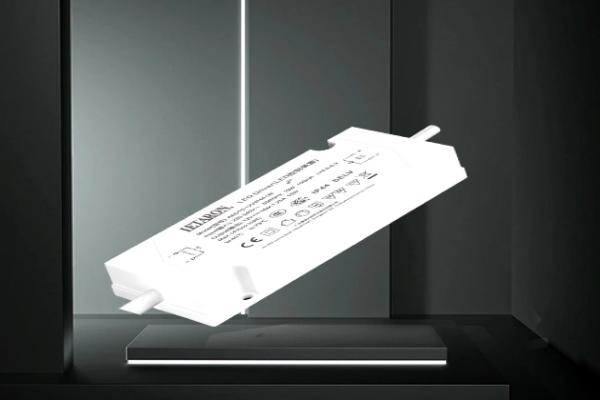
l A complete, matching BOM (including LED strips, LED Drier, aluminum profiles, sensors, and wiring harnesses)
l Drive load calculation and voltage drop verification (to ensure no darkening occurs at the end of long series connections)
l Plug-and-play wiring diagrams that can be used directly for factory assembly
Not necessarily, but we recommend it. Aluminum profiles not only look professional and attractive, but they also effectively dissipate heat, protect the strip lights, and extend their service life.
Of course. Just tell us your installation environment and budget, and we’ll provide you with personalized 1-on-1 recommendations for suitable COB or SMD specifications.
The voltage must match, and you should allow a 20% power margin. Just provide the length and power per meter, and we’ll calculate it for you.
Yes. They require a compatible dimmable power supply or controller. Common dimming methods include PWM, 0-10V, and DALI (depending on the driver system). We recommend confirming the voltage and compatibility before purchasing.
Yes. Standard models can be cut along the marked lines; for bulk orders, we can customize roll lengths and packaging. Feel free to contact us anytime.
We support both. The RGB ecosystem is more mature for SMD, while OEM customization depends on the supplier’s capabilities.